
Why More Pakistanis Are Choosing Online Therapy in 2026: Cost, Privacy & Accessibility Explained
Pakistan is experiencing a quiet shift in how people seek mental health support. Instead of visiting clinics, many Pakistanis are turning to online therapy. Students, professionals, and families in Pakistan and abroad are booking sessions from their laptops without waiting rooms, social exposure, or fear of being recognised.
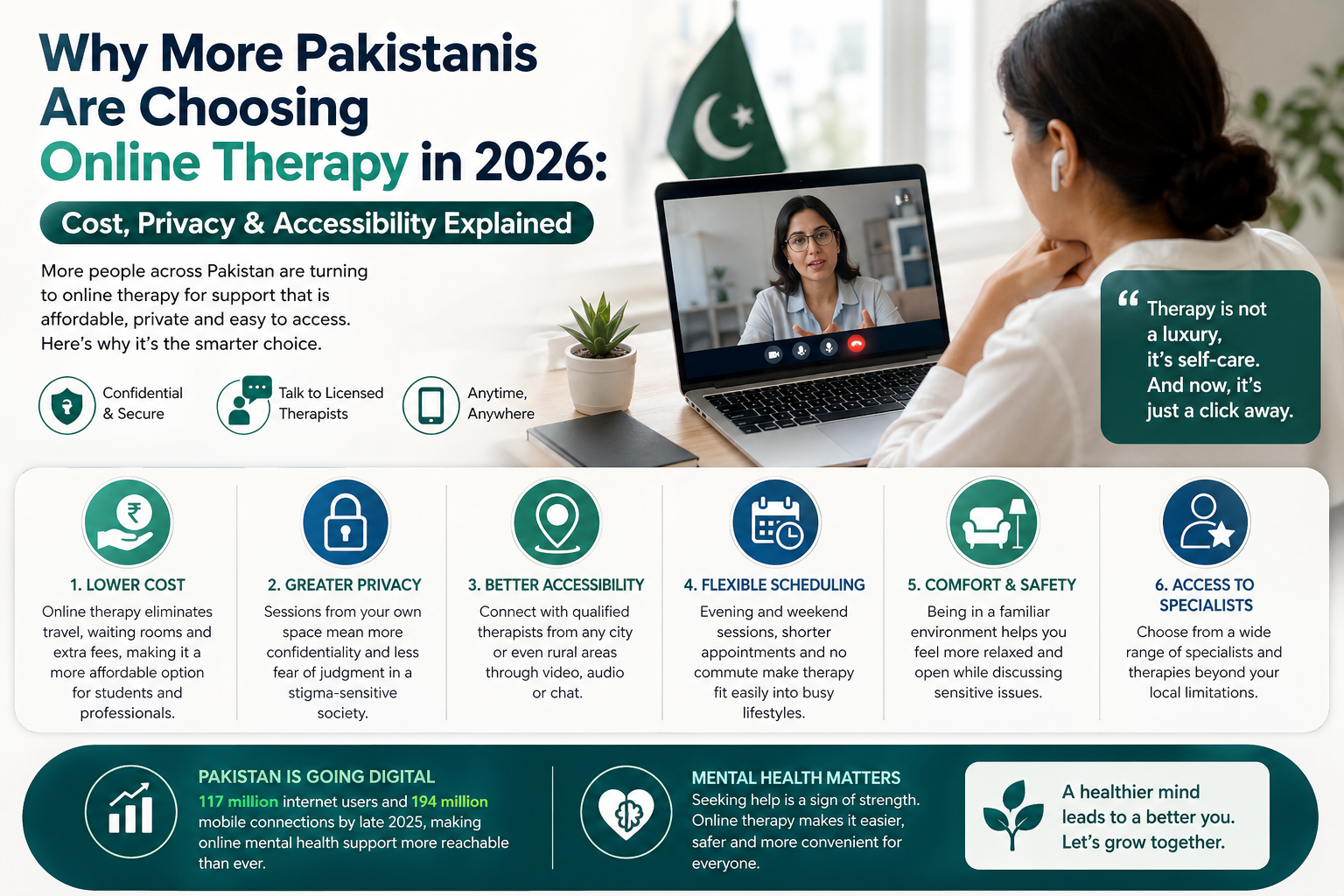
A major reason is social stigma. In Pakistan’s collectivist culture, mental illness is often seen as something that can damage a family’s reputation. Research published in Frontiers in Psychiatry (2025) shows that stigma significantly reduces help-seeking behaviour. A study among medical students in Karachi also found that 59.8% cited social stigma as the biggest barrier to mental health care. Cultural beliefs can also influence decisions. Some people attribute mental health issues to jinn possession, black magic, or divine punishment, leading them to seek faith healers instead of trained therapists.
For women, the stigma can be even stronger because mental health labels may affect marriage prospects and family reputation. Because visiting a clinic can invite social judgment, many Pakistanis prefer online therapy, where they can access professional help privately and safely.
The Hidden Challenge of Privacy in Pakistani Households:
How online therapy is solving this privacy stigma issue:
Online therapy platforms that allow text-based communication alongside video, offer session scheduling at unconventional hours (late evenings or early mornings when family members are asleep), and send discreet billing notifications offer a meaningful solution to this structural privacy challenge.
Solution for women
For women in particular, whether in conservative households in smaller cities or joint families in urban centres, online therapy removes the need to explain a trip outside the home, arrange transport, or account for their time. The session happens on their terms, in the moment they have available.
Solution for men
For men, the privacy equation is different but equally real. In a culture where male vulnerability is actively suppressed, seeing a therapist in person carries the risk of being recognised by colleagues, extended family, or community members. An online session from the office or a private space at home eliminates that exposure.
Cost Comparison: Traditional Clinics vs. Online Therapy
The economic dimension of mental healthcare in Pakistan is deeply significant and frequently underestimated in public discourse.
A consultation with a private psychiatrist in a major Pakistani city typically costs between Rs. 3,500 and Rs. 8,000 per session.
In premium clinics and hospitals in Lahore, Karachi, and Islamabad, rates can go substantially higher.
Psychologists and clinical therapists in private practice typically charge between Rs. 2,500 and Rs. 6,000 for a 50-minute session.
For context, Pakistan’s per capita income in 2024-2025 remains relatively low, and a single therapy session at premium rates can consume a significant share of a middle-class family’s weekly discretionary spending.
Consistent therapy that produces meaningful clinical outcomes requires multiple sessions per week, or at a minimum, weekly sessions over several months. The cumulative cost of in-person therapy makes it structurally inaccessible to the majority of Pakistanis who need it.
Online therapy changes this calculus in several ways:
Lower session costs: Digital-first platforms operating with lower overhead (no clinic rent, no administrative staff, lower logistical burden) are able to offer sessions at reduced rates without compromising on clinician qualifications. Many reputable online platforms offer sessions starting from Rs. 2,000, with introductory sessions and tiered pricing available.
No travel costs: In cities where a single InDrive trip across town costs Rs. 500 to 200, and where traffic can mean an hour of commuting each way, eliminating travel is not a trivial saving.
It is time and money that can be redirected toward more sessions, or simply returned to a person’s already stretched budget.
Flexible scheduling: Many Pakistanis, particularly those in formal employment or with caregiving responsibilities, cannot afford to take time off work for midday appointments. Online platforms that offer evening and weekend slots remove this structural barrier without requiring any special accommodation from an employer.
Reduced indirect costs: Childcare, transport arrangements, and time lost from work all of these indirect costs compound the affordability gap for in-person therapy. Online therapy eliminates most of them.
The Statista Mental Health Market Forecast projects Pakistan’s mental health market to reach USD 136 million by 2029, with growing adoption of telemedicine and digital platforms cited as a primary driver. This is not a fringe trend. It is a structural shift in how mental healthcare is accessed in the country.
The Overseas Pakistani Dimension: Urdu Matters More Than You Think
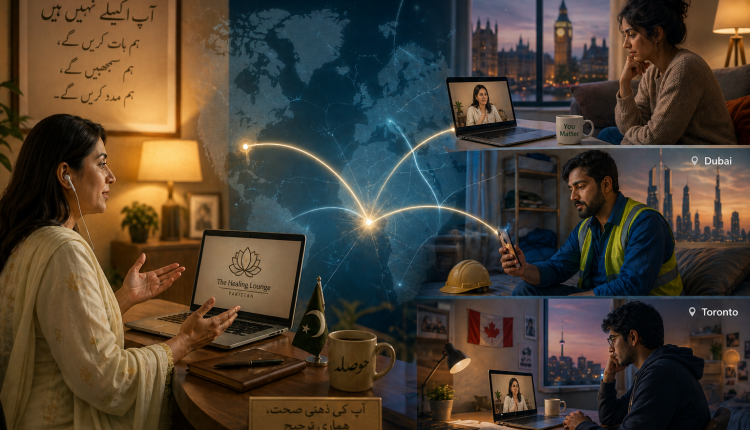
Pakistan has one of the largest diasporas in the world. Millions of Pakistanis live in the United Kingdom, the United Arab Emirates, Saudi Arabia, the United States, Canada, and Australia.
They face a distinct and often invisible mental health burden, and online therapy, particularly with Urdu-speaking, culturally informed therapists, is uniquely positioned to serve them.
The mental health challenges facing overseas Pakistanis are layered and compound each other in ways that Western mental health systems are ill-equipped to address. Migration trauma, the emotional strain of starting over in an unfamiliar country, navigating racism and discrimination, managing visa insecurities, maintaining transnational family obligations, and experiencing the disorientation of living between two cultures, none of these experiences translates neatly into standard therapeutic frameworks developed in Western contexts.
Hypnotherapist Sana Mohsin from The Healing Lounge Pakistan says she has many clients coming from the United Kingdom, Australia and other European countries, saying that they wanted a therapist who can understand Pakistani culture well and speak Urdu.
Language compounds everything. Emotions are processed in the language in which they were first felt. For many Pakistanis, that language is Urdu or a regional language like Punjabi, Sindhi, or Pashto, not English. Research from the South Asian diaspora mental health community has consistently found that therapy conducted in a person’s mother tongue allows for deeper, more emotionally accurate communication.
How Online Therapy Actually Works in Pakistan
One of the most common misconceptions about online therapy in Pakistan is that it is somehow informal, unsecured, or less clinically rigorous than in-person treatment. This is not accurate.
Legitimate online therapy platforms operating in Pakistan work as follows:
Qualified clinicians only: Reputable services employ clinical psychologists holding master’s or doctoral degrees in psychology, psychiatrists who are medically qualified doctors with specialisation in mental health, or counsellors with relevant professional certification and supervised clinical experience.
Before booking, clients should confirm that their therapist holds formal qualifications from a recognised institution.
End-to-end encrypted communication: Professional platforms use encrypted video conferencing and messaging systems that meet data security standards. No session recordings are stored without explicit client consent. Therapist-client confidentiality obligations apply online in the same way as in a physical clinic.
Structured clinical process: A responsible online therapy engagement begins with an intake assessment that evaluates presenting concerns, mental health history, and therapeutic goals.
Continuity of care: Unlike a single consultation with a GP or a one-time psychiatry appointment, therapy is a relationship that builds over time. Online platforms support this by maintaining session notes, enabling consistent assignment of a therapist to a client, and allowing flexible rescheduling when life intervenes.
Crisis referral pathways: Responsible online therapy services have clear protocols for identifying when a client’s needs exceed the scope of online therapy and require in-person psychiatric care, hospitalisation, or crisis intervention. Online therapy is not a replacement for emergency mental health care; it is a primary care complement.
We’ve interviewed one of Pakistan’s popular online mental health organizations, The Healing Lounge Pakistan, and according to them, over 2,000 of their clients have used online therapy for anxiety, trauma, marriage issues, and burnout, with 3000+ online sessions conducted by their team in the span of the last 3 years.
This totally reflects a growing community of Pakistanis who have found this model of care accessible, effective, and worth recommending to others.
Who Should Consider Online Therapy in Pakistan
Online therapy is particularly well-suited for:
- Urban professionals managing burnout, work-related anxiety, or corporate stress who cannot take time off work for appointments
- Women in restrictive household environments who need confidential, private support without logistical barriers
- Young people dealing with academic pressure, identity questions, or family conflict who prefer the lower formality of a digital interaction
- Couples navigating marriage difficulties who want to engage with a therapist without the social exposure of attending a clinic together
- Overseas Pakistanis who want culturally informed, Urdu-language therapy without paying Western market rates
The Bottom Line
Pakistan does not have the luxury of waiting for a perfect mental health system before its citizens start healing. There are too few psychiatrists. The clinics are too far. The stigma is too heavy. The costs are too high.
Online therapy is not a compromise. For many Pakistanis, it is the only realistic path to consistent, qualified, confidential mental health support. It meets people where they are, in their homes, in their private moments, in the language they dream in, without asking them to navigate a healthcare system that has systematically underprioritised their needs.
References & Sources
- World Health Organization, Pakistan Country Office — Psychiatrist density and mental health burden data
- Frontiers in Health Services (2025) — “Closing the mental health gap: transforming Pakistan’s mental health landscape”
- National Psychiatric Morbidity Survey of Pakistan (NPMS), Pakistan Psychiatric Society (2019–2022)
- BJPsych Bulletin (2023) — “Burden of mental disorders by gender in Pakistan: analysis of Global Burden of Disease Study data for 1990–2019”
- BMC Psychology (2025) — “Navigating mental health issues: causal attribution, stigmatization, and care recommendation behaviour in Pakistani adolescents and young adults”
- Frontiers in Psychiatry (2025) — “Cultural narratives, social norms, and psychological stigma: a study of mental health help-seeking behavior in Peshawar, Pakistan”
- Future Science OA (2024) — “Attitude towards seeking professional help for mental health among medical students in Karachi, Pakistan”
- British Asian Trust — Mental Health in Pakistan report
- Journal of Dow University of Health Sciences (2025) — “Where Silence Becomes Suffering: Tackling Mental Health Stigma in Pakistan”
- Statista Mental Health Market Forecast — Pakistan (2024–2029)
- UrduPoint / APP (October 2025) — “Mental health crisis in Pakistan: 57 million affected”